Showing posts with label Book Review. Show all posts

Sunday, September 11, 2011

Oldie, But Far From Classic

Book Review - Whipping Star by Frank Herbert

Every so often I manage to attend the yearly book sale at my local library. Last year I just happened to notice the sign while driving by. . .

Fifty cents (CDN) for a hardcover is a very good price, assuming you can find something you like.

One of the books from my haul last year was Whipping Star by Frank Herbert. Now I admit that the last thing I read by Mr. Herbert was Dune. And that was over a decade ago. What I remember is that the book was kinda obtuse and overly dense. Of course, I was seventeen at the time that I read that tome.

Despite my first impression of Herbert's writing, I bought this novel.

Or perhaps novelette would be a more apt description. The first thing I noticed when I picked up the book was that it was quite thin. Opening the book revealed rather large font. Font almost large enough for the elderly to read.

That being said, it felt kind of refreshing to read a story that wasn't plumped up 500% like many books being written today.

Synopsis

The Empire was built on a gift from a mysterious alien race, a gift that allows instantaneous transport to any place in the universe. Now the last member of the alien race is being slowly tortured to death by a madwoman and it soon becomes clear that once the alien dies anyone who has ever transported will wink out of existence. . . and no-one is known to have not transported.

Verdict

My first impression of the writing was that it was amateurish. While reading those first few pages I surmised that this must be one of Herbert's early works. So I looked up some dates on the internet to confirm this idea, but alas, I was wrong. 1945 appears to be when his first short story was published. 1963 was when Dune appeared. 1970 is when the book form of whipping star was published (apparently a shorter version was published in Worlds of If Science Fiction the year before). I think it's safe to assume that Whipping Star was written to keep Herbert's pot of water boiling.

One thing that intrigued me was Herbert's invention called the Bureau of Sabotage, although it was not fully developed in this short work. In fact it mostly came across as just another government agency.

Herbert also created some cool alien names in this book which mostly offset the negative aspects of the Law of Alien Names. Despite this, the names match up to some pretty average aliens. That's not to say that there isn't some experimentation, especially with the eponymous race (what you couldn't figure that one out from the title?). At least, should a movie ever be made from this story, the aliens couldn't all be played by people with rubber masks.

The main character reads very much like an ethnologist from the 1960's. I picture him as a burly man wearing flannel, arrogant and full of bluster (pretty much exactly like this guy). His ethos is characterized by an oblivious humano-centrism, much as real ethnologists from the mid twentieth century were ignorant of their Euro-centrism. Central to this attitude is also the belief that everything can be understood (usually with only casual observation). Typical of literature from this period, this attitude is always correct and successful.

One last thing - I don't normally condone vandalising library books, but. . .


Rating: **.5/5

Friday, June 24, 2011

Variable Star by Robert A. Heinlein and Spider Robinson


Sadly, I cannot recommend Variable Star by Robert A. Heinlein and Spider Robinson, but read on if you would like to know more.

Synopsis

A young man with a promising career as a composer, and who also happens to be the son of a Nobel Prize winning genius, discovers that the woman he wants to marry is actually the heir to one of the biggest, and wealthiest, dynasties in the solar system. He has been deemed worthy by the patriarch of the family and everything is ready to proceed. One hitch, he has to give up his career as a musician, his surname, and all the dreams he had for the future.

Sounds like a deal, right?

Instead he joins a colony ship heading out for the stars and far, far away from the only woman he has ever loved.

My thoughts

Let me state right off the start that I have never before read anything by Robert Heinlein nor Spider Robinson. Perhaps fans of either author will find more in this offering. Perhaps not.

To begin with, this is not a Heinlein book. Spider Robinson was told not to write one. This is a book based on an unfinished outline for a juvenile novel that Heinlein shelved early in his career. It also carries on with some of Heinlein's themes and is set in a version of Heinlein's 'Future History' universe. How exactly this version differs from Heinlein's own I can't really say, but there is one rather large event half way through the book that I'm pretty sure mucks things up really well.

It most definitely is not appropriate as a juvenile novel.

I don't know how Variable Star compares to Robinson's other works, but this one was not for me. His language skills are proficient enough; I have no problem there. The problem is that there are really three stories here, each of which could have been given their own treatment. Or rather, they should have received their own treatment. The first is a romance story, the second a tale of a generational ship, and the third. . . well I won't spoil it for you. The storylines sit mostly on their own, growing from the previous story but never returning, not really interdependent. Each could probably have been worked to stand on their own as a short story or novella. Each has enough changes in theme or genre to cater to an entirely different audience than the last.

I also found that too much depended on sheer coincidence. It's a pet peeve of mine. I find that it interrupts my suspension of disbelief. But that might just be me, and I realize that coincidence is not only necessary in some degree for most narratives, but that it actually does happen in real life too.

Parting Shots

Apparently there are three sequels forthcoming. Maybe then we'll get an answer to the mystery of the poppy incident.

I did enjoy the little tidbits of Canadiana that Robinson inserted here and there. Now if he would just learn more about the rest of his adopted country. . .

I wish I had bought the paperback version. I got the hardcover on impulse; it was in a bargain bin at Coles. Normally I like to do a little research before a purchase, but hey, the price was right. What I later learned was that the Cover Art, mostly covered up by a text box on my copy, was done by none other than Stephan Martiniere (whom I wrote about here). As you can probably tell from the article behind my parenthetical link, I'm a fan of his work. Such work as is displayed much better on the paperback edition. . .

Rating: **/5

Tuesday, April 19, 2011

Wildside Review!


A while back it was my pleasure to participate in the 'crowdsource proofreading project' for Steven Gould's new ebook edition of Wildside. It was a good deal; I got to read an old favorite and test drive a couple of ebook formats and all I had to do was report any errors I found.

Well, here's my promised review of the book.

Summary:

Young Charlie Newell discovers a doorway to an alternate version of earth where man never existed - the eponymous wildside. Flocks of Passenger pigeons still fill the skies, mammoth and bison still roam the plains, and dire wolves and saber tooth tigers still lurk in the tall grass.

If you found something like this, what would you do?

Make money of course!

Fresh out of High School, Charlie enlists four friends in his (environmentally concious) money making schemes.

Praise and Criticisms:

First of all, I've got to say that I really enjoy this book. I first read it twelve years ago when I was in high school. Re-reading it, although I have done so at least twice before, was a little bit like coming home again. I was also able to pick out more references to Monty Python as well as The Chronicles of Narnia this time around.

Normally I cringe when the label 'Young Adult' is thrown around, especially if it relates to a novel I still enjoy. However, I do admit that the clichéd flaws each character struggles with really lend this book an 'after school special'-esque feeling. There's the gay guy coming out to his friends, the alchoholic, and the guy with father issues who also has trouble getting a girlfriend.

The strangest thing about the 'wildside' of the gate is the ecology. You see, the alternate version of earth on the other side of the gate purportedly differs from the earth on our side of the gate in one key way: human's never existed there. Therefore, the pleistocene kill-off never hapened, and the climate is cooler because no one burned all of those evil fossil fuels.

Now I'm not go into a long debate about climate change, but I will point out that history tells us that earth's climate has never been static. Where I live it was a desert 6,000 years ago. How the Wooly Mammoth would have survived that, I don't know. Either way, I doubt that the adventurers in the novel would have encountered Woods Bison on the wildside. Not with sabre tooth tigers still prowling around. Bison antiquus was the ice age species and was better adapted to deal with dire wolves and saber tooth tigers. Why bison alone would have evolved into a more familiar species, I can't fathom.

But hey, it is, after all, an alternate earth. Who's to say how similar it has to be to our earth, just as long as it pushes your own political agenda…

And I suppose Charlie could have been mistaken in his identification.

My largest complaint, however, stems from something I had failed to fully appreciate before:

Spoiler alert!

Charlie fully expected to confront the government from the very begining! Sure, he didn't expect it to go to such an extreme, but to proceed with an action so likely to raise suspicion as to start selling Passenger Pigeons is kind of a dick move.

Or just plain dumb.

I mean, really? Charlie couldn't come up with a better plan to generate his start up cash?

I still like it, but it's not as good as Jumper.

Rating: ***/5

BTW, Columbicola extinctus and Campanulotes defectus are not extinct…

Tuesday, April 12, 2011

Blindsight by Peter Watts


I don't know what to think about this book. There is a lot I like about it, but at least as much that I don't like. I suppose that's a good thing. I mean, if a book was exactly what I expect it to be, I wouldn't have to read it now would I?

Synopsis

Mysterious objects blaze through earth's atmosphere. A strange construct is detected out in the black, headed this way.

This is a novel about first contact.

Siri 'Cygnus' Keeton, a man with only half a brain, and his artificially augmented crewmates led by a Vampire are sent out to investigate. What they find will bring insight into the nature of the universe as well as the nature of humanity.

This a novel about the futility of our existence.

What I Like

Okay, now that I've got that out of the way lets get into Potential Spoiler Territory.

This is ostensibly a tale of adventure and discovery, an odyssey if you like. I like adventure stories. But in this novel, it is just one the many frames around the novel's core philosophical message. Unfortunately there isn't much action until well into the book, and even that is relatively scarce. The discovery part is slightly more interesting.

Speaking of frames, the most obvious one is the running narration by the protagonist, Siri. I think the decision to go with an unreliable narrator is the true genius of this book because the story is, at least in part, about identity, self discovery, and human ability to perceive reality.

I rather enjoyed the philosophical discussion presented in this book, even if I cannot agree with the conclusions. Although the concepts bandied around are often hard to follow for all the jargon, they are compelling enough to make the effort. The main course of the discussion is solid existentialism with a heavy dose of nihilism wrapped around the philosophy of mind. The tone of it all, if not the content, reminded me very much of the writings of another Canadian author, Karl Schroeder (my current favourite), so I wasn't very surprised that Watts credited him in the afterward with much of the input in this regard.

There is also plenty of speculation about future technologies, the highlight for me being the human hibernation process. I loved the description of the process being as if they were dessicated corpses coming back to life like zombies or something. Of course, as described in the book it only really works if you've had Vampire DNA grafted on to your own.

Which brings me to my next point, the fantastically weird crew. Siri is a man with half a brain, the other half of his skull filled with bits of computer, who acts more like Data, the Android from Star Trek: The Next Generation, always trying to be human. There is also Susan James aka. The Gang of Four who has had her conscience artificially split into four individuals. Then there is their Vampire leader, Serasti, a creature recreated from ancient DNA whose ancestors once stalked ours across the savannah. Even the ship, Theseus, is intelligent. Delightfully quirky!

What I Dislike

The biggest drawback for me is that this book doesn't really get interesting until about page 300. Partly this is because the author spent a lot of time on Siri's backstory; a backstory that is perhaps necessary for the message of the novel, but which I found to be mundane. I also didn't find it to be entirely successful at explaining Siri's affliction. Now I admit to not spending much time researching any potential links between hemispherectomies and psychopathy or autism but I don't believe there is one.

Another major drawback for me is that the characters of Amanda Bates, Isaac Spindzell, and Robert Cunningham are not strange enough. The later two are purported to be amped up humans with so many technological enhancements they can no longer feel with their own hands. Instead, they come across as rather baseline humans with a few more research tools that have trouble walking.

Finally, I felt that the vampire vulnerabilty to right angles, i.e. crosses, was a lame concession to the old vampire legends. According to the timeline in the book, vampires died out long before Christianity developed. How the two would become associated is beyond my comprehension.

Conclusion

I found this novel to be an eclectic mix of Canadian and British SF styles. It has the philosophy of Karl Schroeder, the societal dysfunction of Robert J. Sawyer, and the pessimism of virtually all British SF. He even has a tacked on, tangential ending much like most of Alastair Reynolds' books.

At least I know what James Nicoll was talking about now.

"Whenever I find my will to live becoming too strong, I read Peter Watts."
I would have to say that you should avoid this book if you are:
- looking for an adventure story
- confounded by big words
- prone to depression

Rating:

***/5

BTW, This novel, as well as the rest of Peter Watts' work, is freely available on his website, rifters.com

Friday, April 23, 2010

A Sampling of Steampunk


I recently finished an odd compilation of short stories in the genre called steampunk. Strangely enough, that was also the title of the book.

Unfortunately, I cannot recommend this book to anyone. Ann and Jeff Vandermeer nearly succeeded in eradicating any interest I ever had in the genre.

I'm going to break this down into individual stories to try and give you a better picture of what this book offers than what the back cover tells you. (spoiler alert: the word 'absurd' will be used a lot)

The first story is actually an excerpt from a novel called The Warlord of the Air by Michael Moorcock. This short snippet of a story provided by the editors dumps you into the middle of the plot, shows a bit of dirigible action, and then. . . well, then it stops. There really isn't enough of a narrative here to show any potential and feels more like an incomplete sentence than anything else.

Next up is Lord Kelvin's Machine by James P. Blaylock. This story maintains much of the 'unfinished' feeling of the previous excerpt, jumping breathlessly from situation to situation without much explication. That said, it was probably the best story in the collection and probably the only one to preserve any connection to Jules Verne or H. G. Wells, the supposed progenitors of steampunk. Fortunately, this short story was later reworked into a full novel. I would suggest you look for that instead of this book.

Following that is The Giving Mouth by Ian R. MacLeod. How this story can be called steampunk is beyond me. With it's bleak and depressing tone and reliance on poorly defined magical forces, Dark Fantasy would be a better fit. Hardly worth the time it took to write these few sentences.

A Sun in the Attic by Mary Gentle is a decent story. I admit that the failing here may be mine as I simply find it hard to invest any interest in a story about an alien planet with pseudo Victorian themes that are themselves superseded by the odd juxtaposition of a matriarchal, polyandrous society.

The God Clown is Near by Jay Lake is a celebration of the perverse, yet it is otherwise pointless.

The Steam Man of the Prairie and the Dark Rider Get Down: A Dime Novel by Joe R. Lansdale is not a novel, nor is it worth ten cents. Steampunk? Maybe. Splatterpunk (Gore Horror) / rape porn / snuff porn / bestiality porn? Certainly. This is the most disgusting thing I have ever encountered and I stopped reading less than 1/5th of the way through. This story sounds like it was written by a psychopathic teenager during a stint in Juvie. If I keep this book I will be removing these pages.

The Selene Gardening Society by Molly Brown is quite absurd but better than average for this collection.

Seventy-Two Letters by Ted Chiang is set in an alternate Victorian age in which steam power and clock work devices are replaced by Kabalistic magic. Is that still steampunk? Well written but absurd.

The Martian Agent, A Planetary Romance by Michael Chabon is slow, overwritten, and pointless.

Victoria by Paul Di Filippo is absurd, perverted, and puerile all rolled into one.

Reflected Light by Rachel E. Pollock is boring and pointless.

Minutes of the Last Meeting by Stepan Chapman - Nuclear bombs, nanotechnology, a powerful artificial intelligence. . . why is the Tsar still riding around in a steam powered train and fighting with measly old guns? Must be Baba Yaga, or whatever. Oh yeah, I almost forgot to say that it's absurd.

Finally, the book ends with Excerpt from the Third and Last Volume of 'Tribes of the Pacific Coast' by Neal Stephenson. This is a really good story, but it is post apocalyptic cyberpunk, not steampunk.

All in all - if this is what steampunk is, I'll have none of it.

Rating: */5

Thursday, August 13, 2009

Eragon: an essay on what it means to be cliche


Although it obviously didn't leave much of an impression, I did watch the movie Eragon shortly after it came out on DVD. What I do remember was that I didn't really like it, though I can't remember why. But I do recall the many reviews that state that the movie is a cliched ripp-off of classics like the Lord of the Rings and Star Wars.

With that in mind, let's just say that I never felt a burning desire to read the book.

Then, a couple of weeks ago I chanced upon two separate versions of the book in my favourite place to shop for books: the bargain books section of Mcnally Robinson. One edition was a large white paperback with a picture of a dragon's eye for $3.99 and the other was a large, slightly scuffed up movie tie-in paperback for $2.99. For that price I couldn't resist although I still had doubts that the book would be worth it. So I chose the movie tie in edition.

I'm glad I bought it. In my opinion it wasn't overly cliched or poorly written. At 15, Paolini already had a better vocabulary than I have now, yet I never found the usage to be poor. Some critics have invoked the dreaded term purple prose (dreaded only because no one has ever actually heard of it before outside of a college literary lecture) in regard to Paolini's writing. I must admit, I just don't see it. At no point did the language seem overwrought to me, nor was the 'flow' of the narrative interrupted. And this from a reviewer who has, in the past, abandoned the reading of some books for just that reason.

To cite an example from the second book of the cycle, Eldest, Paolini at one point describes drops of water on a leaf as 'cabochons'. Cabochons are rounded, highly polished gemstones (as opposed to facet cut gems). I think the descriptor is both relevant and appropriate within the narrative, but others apparently do not.

And what does it mean to be cliche by the way. Sure we've seen dragons and dragon riders in fantasy before but these are more good old stand-bys of Fantasy than cliche. A Fantasy novel does not require dragons or dragonriders, yet if we were to suddenly say, "Enough, don't write anymore books with dragon's or dragonriders in them!" wouldn't the genre be missing something? And where would the madness end?

"No one can use swords. Take out all the wizards. Horses are for cowboys, not fantasy heroes. . ."

Would it even be Fantasy anymore?

Now that's not to say that there can't be innovation within the genre. Naomi Novik found a new twist on that theme by setting her Temeraire series during the Napoleonic era rather than a fictional psuedo medieval world. But Eragon is no less 'good' because of the slightly more traditional setting. In fact, the world of Eragon, a magical continent called Alagaësia on an unnamed world, has been fully conceptualized and developed, including a very nice map drawn by the author himself. It isn't even strictly eurocentric as the author based the landscape on his native state of Montana. The government is highly centralized and hardly feudal in the traditional sense. (one nitpick here for Mr. Paolini, should he ever read this blog: The leader of an empire is an emperor, not a king!)

Okay, so I'm fairly forgiving when the fun factor outweighs the trite factor. But let's face it, there's nothing new under the sun. Shakespeare was stealing from existing sources when he wrote his plays. Even Star Wars is based on the structure of the "hero's journey", a pseudo outline supposedly distilled from various classic tales. In fact, it's even been claimed that there are really only seven stories, everything else is just details.

I tried reading a snarky review of Eragon that used terms like 'Gary Stu' and 'gormless'. Unfortunately I think the reviewer was more concerned with being snarky than in giving an honest review. In her defense, she was simultaneously reviewing the movie and the book. Yet she seemed to miss the point far too often. For instance, she claimed that Paolini was lax in his research because Eragon's poor, starving family had a multi-room, wood floored house with a stove, yet real medieval peasants would have a small, one room shack with a dirt floor. I might have agreed with her if this had been a story about real medieval peasants. . .

And finally, lets not forget that it has been 10 years since Eragon was published. Paolini started writting the story when he was 15. It has been reported that he didn't intended for the book to be published, writing, instead, for his own personal pleasure and drawing heavily on his favorite stories by other authors. No wonder it ended up the way it did.

Conclusion: Perfect? No. Completely original and innovative? No. Entertaining and compelling? Yes.

Rating ****/5

Relevant links:

www.alagaesia.com
shurtugal.com
wiki: Criticism_of_the_Inheritance_Cycle (shurtugal.com)
en.wikipedia.org/wiki/Eragon

Tuesday, December 30, 2008

Bazil Broketail Series

And now for the F of SF & F:

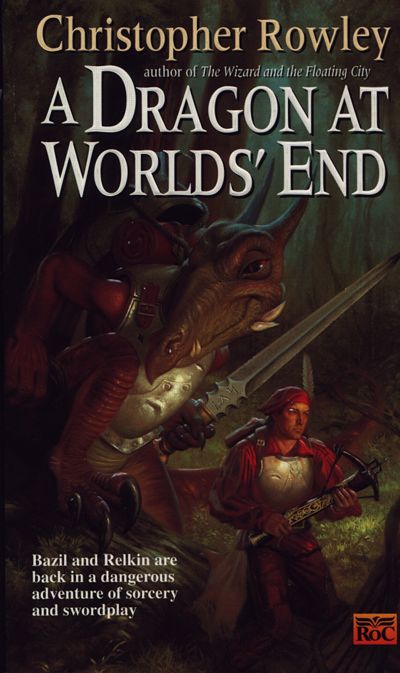
A few years ago I was browsing in the SF & F section of my local McNally Robinson and stumbled across A Dragon at World's End by Christopher Rowley. I bought it on Impulse because I liked the sword pictured on the cover. I mean, A dragon with a sword? Awesome! Otherwise it was the first fantasy novel I'd bought since my dissapointment with the fantasy paperback pulp mill back when I was in high school.

Yikes, I don't think I can count the number of times I've bought a book only to find out it's the third or fourth in a series. Fortunately the books of the Bazil Broketail series are quite readable as standalone novels. Recently I was able to pick up the rest of the books in the series from a combination of used bookstores and AbeBooks.

Although the series is named for him, Bazil the broketail dragon is the companion of the protagonist of the novels, the dragonboy Relkin, although the point of view is not limited to him. The narrative usually follows the boy but often switches to one of the witches or their allies and sometimes to the bad guys. Seldom does it follow a non-human. Further, while the POV is mostly third-person limited, it sometimes switches to omniscient.

I can't really explain why I like this series so much. Certainly these books have flaws. I guess it really just boils down to the fact that they are just plain fun. The world is vividly realized and has every detail fits within the internal logic of that universe.

The dragons in this universe deserve a word or two of description. First of all, most of the dragons in the books cannot fly. These are the so called wyverns of the Argonath. Now if you look up the classical definition of wyverns in our world you'll probably find a description like "a small dragon with two legs and bat-like wings". In Bazil's world, however, wyverns are a branch of the dragon family that originally lived along ocean coasts both in the water and out. They have no wings but many can walk on just two of their four legs. Only the large four ton brasshides go about on all fours. Wyverns can talk and are dexterous enough to manipulate tools such as shovels, axes, and swords.

Long ago the wyverns pledged to fight for the humans of the Argonath. In return they are kept well fed and are served by dragonboys who trim their nails and such. While they prefer fish or meat, they will eat the much more readily available noodles and bread - so long as there is plenty of akh to put on it. The ingredients of akh vary, but the best is made from hot peppers and fish sauce. It is said to be too strong for humans.

There are wild dragons that normally live in the frozen north but sometimes range down and harass humans. These wild dragons can fly but neither they nor the wyverns can beathe fire. Only the legendary ancestors of the modern dragon had this ability.

Amongst the flaws of the series, one of the worst is the the relative power magic has in this universe yet it is underutilized. For instance, In the last novel the new main antagonist attacks by creating huge tentacled swamp worms that batter down all defenses and seem impervious to most attacks. However, he only sends one wave of one worm per fort. Why wouldn't he continue sending worm after worm? From what I can tell using magic doesn't seem to be that taxing to him. His bag of magic tricks all seem to be based on making a big fire and throwing someone in. In return, many soldiers of the Argonath were killed by the worms, including dragons.

To me, however, the most annoying flaw is that Mr. Rowley often skips parts of narrative. For instance, in the first portion of the eponymous first novel Bazil and Relkin spend quite a bit of time trying to get into the army. Yet once they do get conscripted the story immediately shifts to a campaign against the Master's of Padmassa, jumping over the intervening campain against the Teetol people. Now I understand that the lesser campaign doesn't have much to do with the series' main plot against the evil wizards but it sure would have added alot to the story of Bazil and Relkin.

In fact, the novels mostly seem to fit into a pattern whereby the first half follows the adventures of Bazil and Relkin, often meaning little to the rest of the plot, then there is a massive battle against the bad guys, then everything gets wrapped up in a few pages. There are, of course, several exceptions to this pattern, but still. . .

Judging from the uniform size of each novel I'm guessing he had a contract for about 500 pages a book.

Series rating:
****/5

Monday, December 22, 2008

Peter F. Hamilton's Paradox

I've been reading quite a bit of British SF recently. I'm still not sure that I like it.

Peter F. Hamilton never fails to weave a compelling tale. So far I've read his Novel Fallen Dragon, the Commonwealth Saga, and a third of his Night's Dawn Trilogy. All are in the Space Opera genre.

From these books I have concluded that his greatest talent lies as a world builder. Unfortunately this leads to his greatest flaw, excessive bloat in his novels. What is bloat? Basically it's the fluff inserted in what should be a 300 page novel that makes it into a 700 page novel. So many times when reading these books I had to fight the urge to just skip a few pages. For instance, every transition in narrative is lead by a description of the planet, region, city, neighbourhood, or any of those in combination, no matter if he has previously introduced the area. Such a description can range from the cultural to the economic, the political to the personal, or the geographic to the biological.

Fine, that at least can add to the atmosphere. What really gets me are the long segments where politics and economics are discussed. It's kinda like watching CSPAN or asking an accountant how his day went.

Another major annoyance I have found with Peter Hamilton's novels is the constant shifting of POV (point of view) between a large number of characters. In the larger novels there can be so many characters that when the narrative shifts I'm often left wondering, "Who is this?"

Potential readers should also be warned that Hamilton's work is rife with violence and fairly graphic sex.

So now let me get to the point implicit in the title of this post:

My favourite Hamilton work so far is Fallen Dragon. It's gritty and often quite dark, yet I found it compelling and the characters easy to relate to. Also, it has a unique set up regarding space travel in that while FTL (Faster than Light) travel is available, it's too expensive. Furthermore they don't have artificial gravity so travellers must cope with the effects of zero gravity. However, the plot of revolves around one huge chronological paradox.

(Major spoiler alert!)

Okay, here's a quick rundown of the sequence of events that lead to the paradox (please, if you haven't read the book, don't read any further):

A rich teenager finds out that his dad hired a girl to be his girlfriend (remind me again why he hates his dad) so he runs away. To get off planet a friend of his gives him some very powerful hacking software. A violent military career follows until he travels to a planet where he finds out that the hacking software came from alien technology. More plot ensues, he learns about an alien time portal which he uses to go back in time to before he left his home planet. Using technology gained from the aliens he makes himself young again but changes his identity and becomes the friend that gave himself the alien software to begin with.

So how does that work? He's only able to leave his home planet in the first place because he's given the alien technology. But his future-self wouldn't get the technology unless he left his home planet. So how does the cycle begin? Furthermore, he wouldn't be aware of or be able to infilitrate the base of the humans using the technology without having the technology himself.

Rating for Fallen Dragon:
****/5